
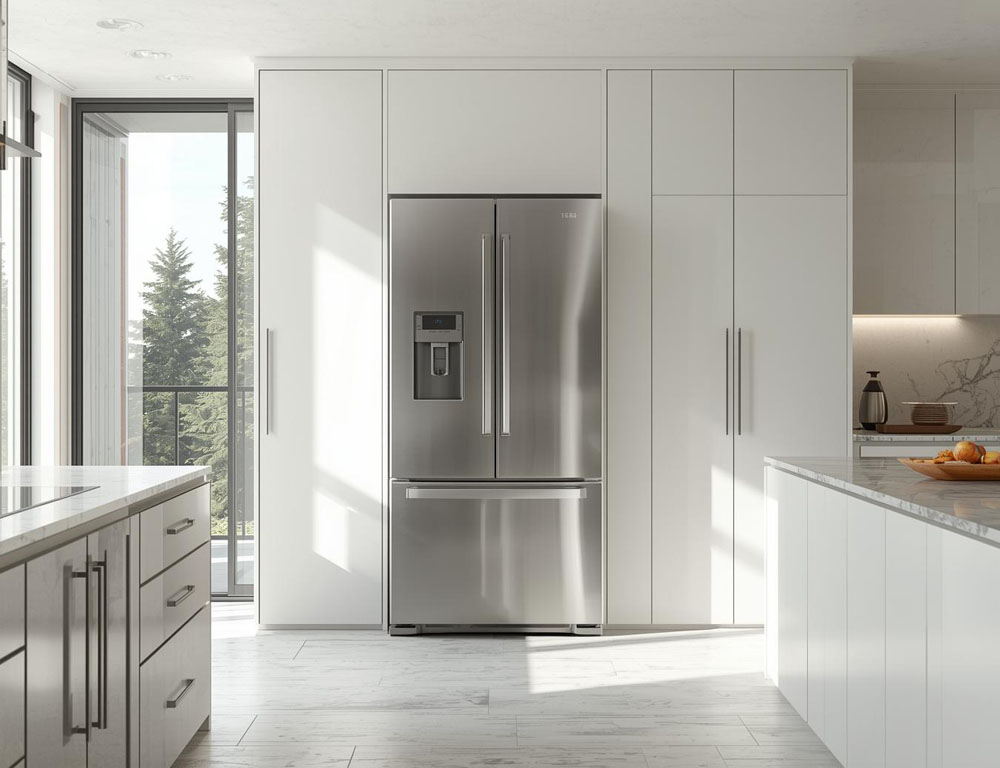
A refrigerator is one of the few household appliances that operates around the clock, without breaks or days off. That is why the question of how much electricity a refrigerator consumes interests almost everyone who pays for electricity or plans to buy new appliances.
At first glance, it seems that a refrigerator does not consume much. But over a month and a year, the numbers can be surprising. In this article, we will figure out how much electricity a refrigerator consumes per day and per month, what this depends on, which energy efficiency class is considered economical, and how to realistically reduce electricity costs without harming food storage.
- How much electricity does a refrigerator consume per day
- How much electricity does a refrigerator consume per month
- What affects a refrigerator’s electricity consumption
- Refrigerator energy efficiency class: what A+, A++, and A+++ mean
- Refrigerator power vs. actual consumption
- How to reduce a refrigerator’s electricity consumption
- How much electricity does a refrigerator consume compared to other appliances
- How to correctly calculate a refrigerator’s electricity consumption
How much electricity does a refrigerator consume per day
To understand the actual electricity consumption of a refrigerator, let us start with the shortest period — one day.
On average, a modern refrigerator consumes:
- 0.7–1.2 kWh per day — energy-efficient models;
- 1.2–1.8 kWh per day — standard two-compartment refrigerators;
- 2 kWh or more — older or large models with additional features.
It is important to understand that a refrigerator does not operate at full power all the time. The compressor turns on cyclically — when it needs to maintain the set temperature. That is why information about how many watts a refrigerator consumes does not give the full picture, while kWh per day is the key indicator.
How much electricity does a refrigerator consume per month
Now let us convert daily consumption into monthly consumption — this is the indicator that most users are interested in.
An approximate calculation looks like this:
- 0.8 kWh × 30 days = 24 kWh per month;
- 1.2 kWh × 30 days = 36 kWh per month;
- 1.8 kWh × 30 days = 54 kWh per month.
In other words, a refrigerator’s monthly electricity consumption usually ranges from 25 to 55 kWh, depending on the model and operating conditions.
When it comes to money, even a difference of 10–15 kWh per month turns into a noticeable amount over a year. That is why the topic of refrigerator energy consumption is directly related to saving the family budget.
What affects a refrigerator’s electricity consumption
The same model can consume different amounts of electricity under different conditions. Let us look at the main factors that actually affect energy use.
Refrigerator capacity and electricity consumption
The larger the total capacity, the more electricity is required for cooling:
- up to 250 L — minimal consumption;
- 250–350 L — average consumption;
- over 400 L — increased consumption.
Large family refrigerators physically cannot be as economical as compact models.
Number of compressors
- One compressor — a simpler design, a lower price, but less flexible temperature control.
- Two compressors — more precise regulation, often higher comfort, but slightly higher electricity consumption.
The difference is not critical, but it exists.
No Frost and energy consumption
The No Frost system significantly simplifies daily use, but it comes at a cost:
- fans;
- automatic defrosting;
- additional heaters.
As a result, No Frost energy consumption is usually 10–20% higher than that of conventional models.
Room temperature
A refrigerator that is placed:
- near a stove;
- near a radiator;
- in direct sunlight,
will consume significantly more electricity. Room temperature directly affects how often the compressor turns on.
Refrigerator energy efficiency class: what A+, A++, and A+++ mean
One of the most important parameters when choosing a refrigerator is its energy efficiency class.
Briefly about the differences:
- A+ — a basic level of energy savings;
- A++ — approximately 20–25% more efficient;
- A+++ — the most energy-efficient option.
A refrigerator with an A+++ rating can consume dozens of kWh less per year than an A+ model. Over long-term use, this fully offsets the price difference.
That is why the query “which refrigerator class is more economical” is so popular before purchasing.
Refrigerator power vs. actual consumption
Users often look at the “refrigerator power” rating in watts and draw incorrect conclusions.
It is important to know:
- power (W) — peak load;
- consumption (kWh) — actual energy use over time.
Even if a refrigerator has a power rating of 300–400 W, it does not operate continuously. That is why calculations always use kWh per day or per month, not watts.
How to reduce a refrigerator’s electricity consumption
Even without buying new appliances, it is possible to significantly reduce energy costs.
Practical tips that work
- do not put hot food into the refrigerator;
- do not keep the door open longer than necessary;
- regularly clean the rear condenser grille;
- do not overload the compartments with food;
- set the optimal temperature instead of the minimum.
These small habits really help reduce a refrigerator’s electricity consumption by 10–15%.
Correct temperature settings
Optimal values:
- refrigerator compartment: +4…+5 °C;
- freezer compartment: –18 °C.
Lowering the temperature “just in case” only increases energy use without extending food storage life.
How much electricity does a refrigerator consume compared to other appliances
For a better sense of scale:
- refrigerator — 25–55 kWh/month;
- washing machine — 10–20 kWh/month;
- water heater — 80–150 kWh/month;
- electric kettle — 10–25 kWh/month.
A refrigerator is not the biggest energy consumer, but due to continuous operation, its contribution to total electricity costs is noticeable.
How to correctly calculate a refrigerator’s electricity consumption
The most accurate methods are:
- check the annual consumption in the technical documentation and divide it by 12;
- use a household watt meter;
- base estimates on the energy efficiency class and capacity.
This provides a realistic picture of household electricity expenses.
So, the answer to the question of how much electricity a refrigerator consumes looks like this:
- per day — on average 0.8–1.8 kWh;
- per month — approximately 25–55 kWh.
A refrigerator’s electricity consumption is affected by capacity, energy efficiency class, the No Frost system, installation conditions, and user habits. The right choice and proper use make it possible to save electricity without any discomfort.