
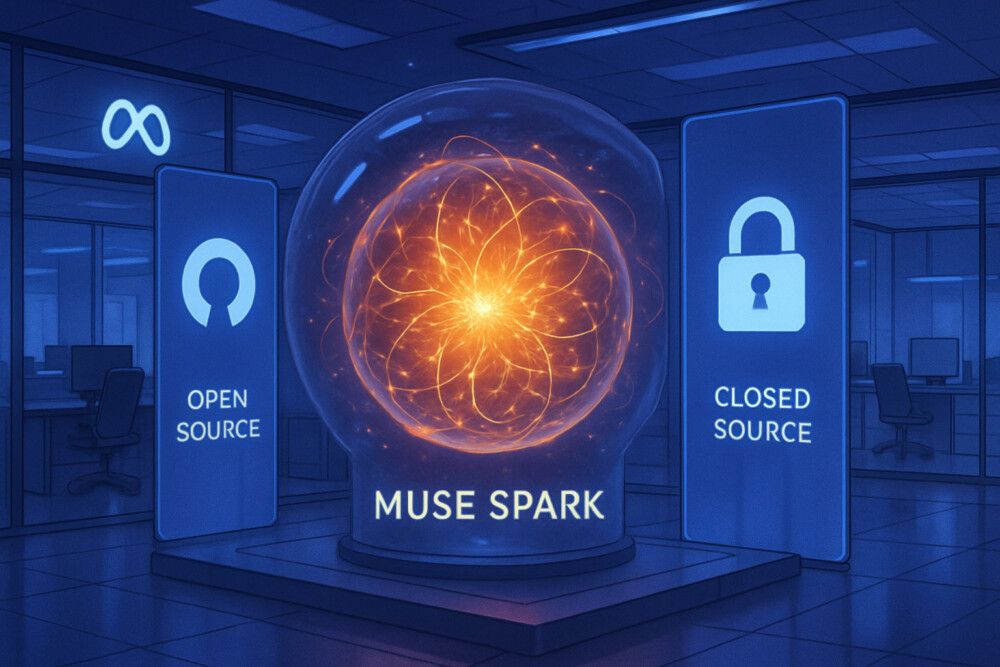
Meta has unveiled Muse Spark, the company’s first major AI model since Mark Zuckerberg rebooted its AI effort, and the launch puts a sharper edge on the company’s new direction. The model arrives under Meta Intelligence Labs and is being framed as part of Zuckerberg’s push toward personal superintelligence, but Meta says it will remain closed source for now.
Meta Intelligence Labs now sits at the center of the effort
Meta Intelligence Labs is the new home for Meta’s AI work, and Muse Spark is the first major model to emerge from that structure. The reorganization matters because it shows the company is not treating this as a routine product update. Instead, Meta is presenting the model as evidence of a broader reset in how it wants to compete in AI.
The announcement does not include technical specifications, access details, or a release timeline beyond the fact that Meta introduced the model on Wednesday. That leaves the launch defined more by strategy than by product detail.
Personal superintelligence is the stated goal
Personal superintelligence is the concept Meta is using to describe where it wants its AI work to go next. Muse Spark is being positioned as a step toward that goal, tying the model directly to Zuckerberg’s current AI strategy rather than to a single standalone release.
That framing is important because it suggests Meta is trying to define its AI roadmap around a long-term ambition, not just a model launch. The company is signaling that Muse Spark is part of a larger effort to build toward a more capable system, even though it has not laid out the technical path in public detail.
Closed source keeps Meta on one side of the debate
Closed source AI is the other defining part of the announcement. Meta says Muse Spark will stay closed source for now, which places the company firmly in the middle of the open-source vs. closed-source AI debate at a moment when that divide remains one of the industry’s most visible fault lines.
The decision is notable because Meta has long been associated with a more open posture in parts of its AI work, but this launch points to a different emphasis. By keeping Muse Spark closed, Meta is making a clear statement about control, distribution, and how it wants to position its most important new model.
What the launch says about Meta’s AI strategy
Mark Zuckerberg AI strategy is now easier to read through this release: Meta is pushing harder on AI, organizing the work under a new division, and tying the effort to a personal superintelligence goal while withholding the model itself from open release. That combination makes Muse Spark less a standalone product story and more a signal about where Meta wants to compete.
The launch also intensifies the broader open-source vs. closed-source AI debate because it comes from a company that has the scale to influence expectations on both sides. For now, Muse Spark’s main significance is not what Meta has revealed about the model itself, but what the company’s choices say about its next phase in AI.
Meta has put a marker down. Muse Spark shows the company is back in the race with a new internal structure, a more explicit long-term ambition, and a closed-source model at the center of it.