
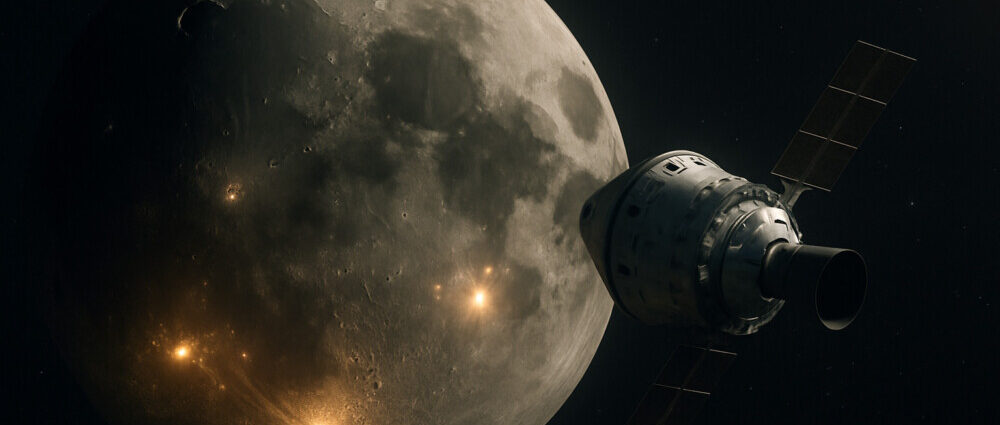
Astronauts aboard Orion saw as many as six brief flashes on the Moon’s far side during an Artemis II flyby, a rare direct look at meteorite impacts on the lunar surface. The flashes were identified as small meteorites striking the Moon while the crew passed overhead.
What the Artemis II crew saw
The Artemis II crew observed the flashes during a flyby of the Moon’s far side, where the impacts appeared as short bursts of light rising from the surface. The report says the astronauts saw up to six of these flashes from the spacecraft.
The observation stands out because it came from crewed spacecraft in real time, rather than from later analysis of images or sensor data. The report does not identify which astronauts saw the flashes or where on the Moon the impacts occurred.
Why the sighting matters
The Artemis II observation matters because it offers a direct view of lunar meteor impacts as they happen. That kind of real-time sighting could help scientists better estimate how often the Moon is hit by small objects.
It may also help researchers study how the lunar surface changes after impacts. Even brief flashes can mark active processes on a body that often appears static from a distance.
Orion and the far side of the Moon
The Orion spacecraft provided the vantage point for the sighting during the Moon flyby. From that position, the crew had a view of the far side, where the flashes were visible against the lunar surface.
Because the impacts were seen from the spacecraft itself, the event adds a human observation to a field usually built from instruments and remote imaging. The report describes the flashes as brief and small, consistent with meteorites hitting the Moon rather than larger events.
A rare kind of lunar observation
Direct astronaut observation of lunar meteor impacts is unusual, and that rarity is part of what makes the Artemis II report notable. The sighting suggests crewed missions may be able to capture details about lunar surface activity that are easy to miss from Earth.
For now, the key takeaway is simple: during a far-side flyby, the Artemis II crew saw the Moon get hit in real time. That makes the observation useful not just as a striking moment, but as a data point for understanding impact activity on the lunar surface.