
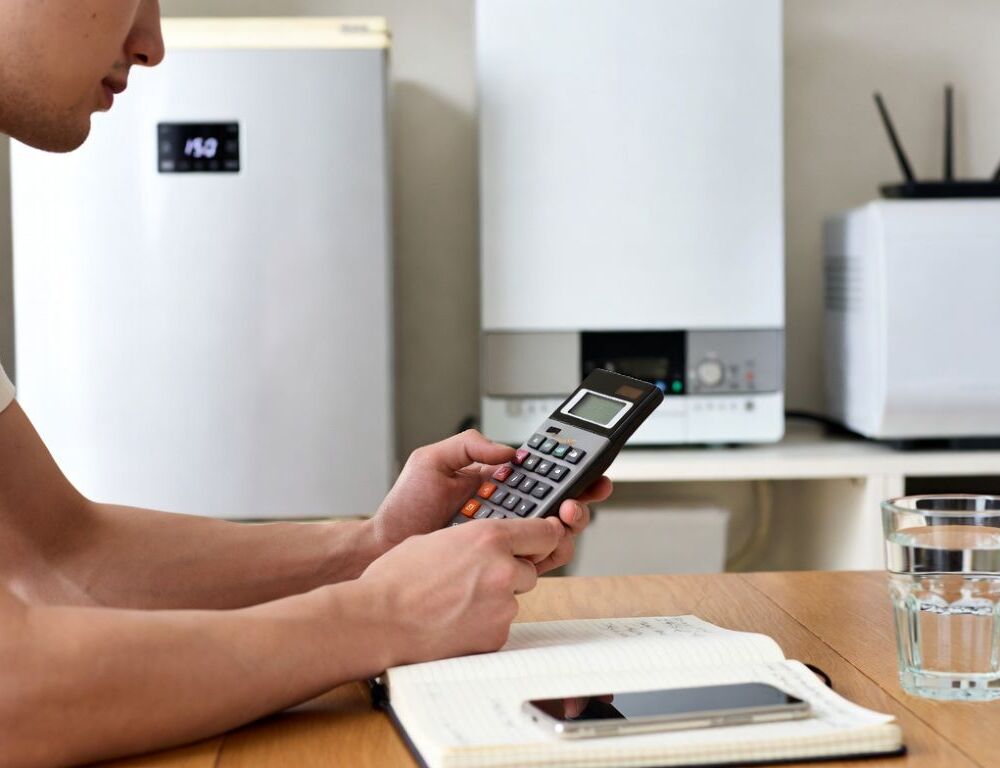
The number of Wh you need for a refrigerator, boiler, and router is based on real average watts, the runtime you want, and conversion losses.
A practical mental model is simple: Wh = average W × hours, then add a buffer for inverter losses and startup peaks. In an apartment, peak watts can matter as much as total Wh, especially for a fridge compressor.
- What formula should you use to calculate Wh for apartment essentials?
- What quick checks help you avoid buying the wrong capacity in 2 minutes?
- How many Wh for a router, and what is the fastest way to verify the load?
- How many Wh for a refrigerator for 6–12 hours?
- What refrigerator startup peaks matter when picking an inverter?
- How many Wh for a boiler if electricity is only needed for controls?
- What inverter losses should you budget in a Wh calculation?
- What mistakes most often underestimate Wh and cut runtime?
- What is the simplest reliable approach to sizing Wh for an apartment?
What formula should you use to calculate Wh for apartment essentials?
A Wh formula for apartment essentials works when you calculate energy (Wh) separately from peak power (W).
- Energy:
- Wh = (average load in W) × (hours)
- Losses:
- for 230 V AC output, a 15–25% buffer is a common starting point for inverter losses
- add extra if you will charge phones and laptops from the same station
- Buffer:
- add 10–20% for real-world cycling, temperature effects, and measurement error
Validation: measure average watts with a plug-in power meter for 30–60 minutes, and measure a fridge over 24 hours if you want a solid number.
What quick checks help you avoid buying the wrong capacity in 2 minutes?
Quick capacity checks work when you lock the scenario and the time window first.
- Scenario: router only, router + boiler, router + fridge, or all together.
- Runtime: 3 hours, overnight (8–10), half-day (12), full day (24).
- Outputs: what can run on DC to avoid AC inverter losses.
- Peaks: whether your fridge needs a higher surge rating at startup.
Validation: if the station cannot handle peak W, the device may fail to start even when you have enough Wh.
How many Wh for a router, and what is the fastest way to verify the load?
A router Wh estimate is most accurate when you measure it, because nameplate ratings are often upper bounds.
Steps:
- Measure average watts on AC with a power meter for 10–15 minutes.
- If your power station supports DC output that matches your router’s requirements, DC often improves runtime because it reduces conversion losses.
- Calculate Wh: average W × hours.
Validation: if the router reboots on battery, check the power adapter requirements, try a different output (DC vs AC), or add headroom on the power side.
How many Wh for a refrigerator for 6–12 hours?
A refrigerator Wh estimate for 6–12 hours is best built from daily energy use plus a buffer for compressor cycling and inverter losses.
A practical method:
- Find an annual or daily energy figure from the label/manual if available.
- Convert annual kWh to daily Wh: (kWh/year ÷ 365) × 1000.
- Convert daily Wh to your target hours, then add a 20–30% buffer.
For scale, ERIA Energy Security White Paper 2024 (MEPS chapter) gives examples where 400 L refrigerating appliances are associated with maximum annual energy consumption figures such as 334 kWh/year (without freezer) and 434 kWh/year (with freezer) in Thailand, and 630 kWh/year for a 400 L class in Malaysia. That puts the average-power order of magnitude in “tens of watts”, not constant hundreds.
Validation: if you want device-specific numbers, use how much electricity a refrigerator consumes per month and per day as a reference point, then confirm with a 24-hour meter reading.
What refrigerator startup peaks matter when picking an inverter?
Refrigerator startup peaks matter when picking an inverter because a compressor can draw a short surge that is much higher than steady-state watts.
What to do:
- Check the station’s surge rating, not only the continuous rating.
- If the station trips at startup, you likely need more headroom on peak W.
- A safer fallback is to reduce the scenario to critical loads while you reassess the inverter requirements.
Validation: run a short real-world test with multiple fridge start cycles to see whether the inverter handles the surge reliably.
How many Wh for a boiler if electricity is only needed for controls?
A boiler Wh estimate for controls depends on standby draw versus active operation with pumps and fans.
Steps:
- Read your boiler manual for standby and maximum electrical power.
- Calculate two scenarios: standby-only and active operation.
As an example, Vaillant ecoTEC plus open vent installation and servicing instructions list standby electrical power consumption at 2 W and show maximum electrical power consumption for some models in the tens of watts (for example 44 W). This is useful when you want a grounded starting point before measuring your specific setup.
Validation: if the boiler shows errors on battery power, stop and verify manufacturer requirements, and avoid experimenting with wiring or control terminals without qualified service.
What inverter losses should you budget in a Wh calculation?
Inverter losses should be budgeted in a Wh calculation because delivered AC energy is typically lower than the battery’s rated capacity.
A practical rule:
- add 15–25% for AC inverter use
- use DC outputs where possible to reduce losses
Validation: run a 30–60 minute test under real load and adjust your buffer based on measured runtime.
What mistakes most often underestimate Wh and cut runtime?
Mistakes that underestimate Wh usually come from ignoring peak power and conversion losses.
- Counting Wh only, while ignoring peak W.
- Skipping measurement and relying on generic averages.
- Using no buffer for inverter losses and cycling loads.
- Powering everything through AC when DC would work.
Validation: if your estimate is tight, add 20% capacity or narrow the scenario to the devices you truly need.
What is the simplest reliable approach to sizing Wh for an apartment?
A simple reliable approach to sizing Wh for an apartment is measuring average W, multiplying by the target hours, then adding a buffer for inverter losses and startup peaks. Once your numbers are set, it becomes easier to choose a power station for an apartment that matches both Wh and peak W.
Sources: