
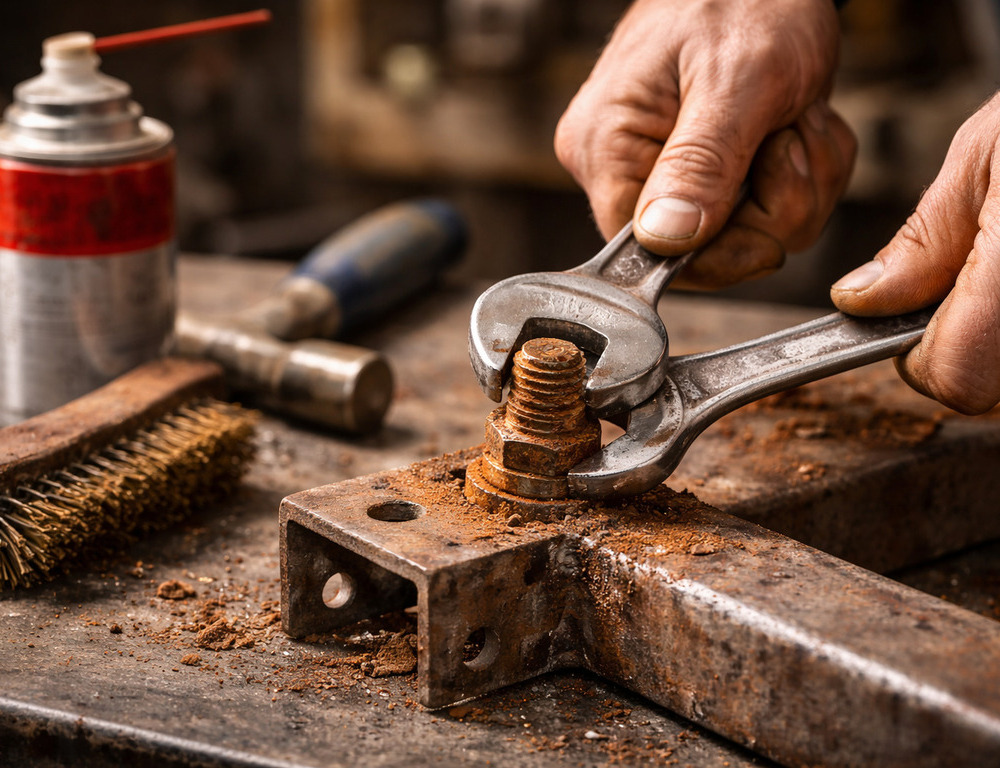
There is a particular sound that ruins your mood: the wrench slips, the flats shine, and the bolt does not move at all. Fighting rust with brute force looks fun in movies, but in a garage it often ends with rounded heads or a snapped stud. If you want to know how to remove a rusted bolt, a step-by-step sequence works better: start with the boring basics, then penetrant, and only then heat and heavier mechanics.
Quick Answers Before You Start
Which way do you loosen a bolt and nut?
Most fasteners use right-hand threads: loosen counterclockwise when looking at the bolt head or nut. Left-hand threads exist on some parts, and those loosen the opposite way.
Why won’t the bolt move even with a long breaker bar?
Rust locks the threads, and sometimes threadlocker or heat cycling adds “seizure.” A longer lever without prep often leads to rounded flats.
Is WD-40 or a penetrant better?
WD-40 can help as a general lubricant, but a dedicated penetrating oil is usually better for seized, rusted fasteners.
When should you stop before you break something?
If the head starts to round and the force keeps climbing, switch tactics. Ten minutes of prep is cheaper than drilling and extracting.
Prep: Five Minutes That Save an Hour
What should you do before turning?
First, brush the joint with a wire brush and remove loose rust. The cleaner the threads area, the better the penetrant can work.
How do you choose the right tool to avoid rounding?
A 6-point socket on a ratchet or breaker bar is safer than an open-end wrench. If you have access, impact-rated sockets help.
Do you need to hold the back side?
Yes, if a bolt passes through a nut: hold the opposite side with a wrench. Otherwise you may spin two parts and waste effort.
Decide Based on How Stuck It Is
What if it is tight but it moves?
Use a back-and-forth motion: loosen a bit, then tighten slightly. This breaks rust and lowers the chance of snapping.
What if it does not move at all?
Move to penetrating oil, give it time, and only then try again. A hard jerk at the start is usually the worst move.
What if the flats are already damaged?
Go straight to a “grip” method: a slightly smaller socket driven on, extractor sockets, or locking pliers.
Table: Which Method to Try First
| Situation | Try first | Try next |
| Tight but moving | back-and-forth + 6-point socket | penetrant + wait |
| Not moving | penetrant + tapping | heat + impact |
| Rounded flats | tight socket/locking pliers | extractor |
| High snap risk | penetrant + steady force | heat + reapply penetrant |
Working Methods for a Seized Bolt
How do you apply penetrating oil correctly?
Apply it to the joint and the exposed threads, then wait 10–30 minutes. For heavy rust, repeat 2–3 times. After each application, tap the bolt head lightly to help the fluid work deeper.
Does tapping with a hammer help?
Yes, but not wild swings. Short, controlled taps on the head or nut crack rust in micro-gaps. Use a wood block if the area is delicate.
When should you use heat, and how do you do it safely?
Heat expands metal and helps break seizure. Heat the nut or the area around the threads, not the entire bolt, and be careful around rubber, wiring, and paint. Let it cool slightly, then try to loosen. A common pattern is “heat → penetrant → attempt.”
What does an impact tool change?
If you have an impact wrench, the pulses can work better than constant torque. It reduces rounding risk and helps break the fastener free.
Common Mistakes That Make It Worse
Why shouldn’t you jump on the wrench?
A sudden load puts maximum stress on threads and the bolt shank. If corrosion has weakened it, snapping becomes likely.
Why is it bad to turn with a loose-fitting tool?
Play turns into rounded flats quickly. A proper socket now beats an extractor later.
What if it starts to move but squeaks and jerks?
Go back to back-and-forth, add penetrant, and slow down. This lowers the chance of stripping threads or jamming again.
Final Check Before Your Last Attempt
Did you cover the basics before applying big force?
- You confirmed which way to loosen a bolt and nut and ruled out left-hand threads.
- You used a tight 6-point socket and held the back side when needed.
- You gave penetrant time and used back-and-forth.
- If risk was high, you used heat or impact.
Most of the time, success is not about strength but about sequence. When you work in steps and avoid rushing, removing a rusted bolt stops being a gamble and becomes a routine fix.