
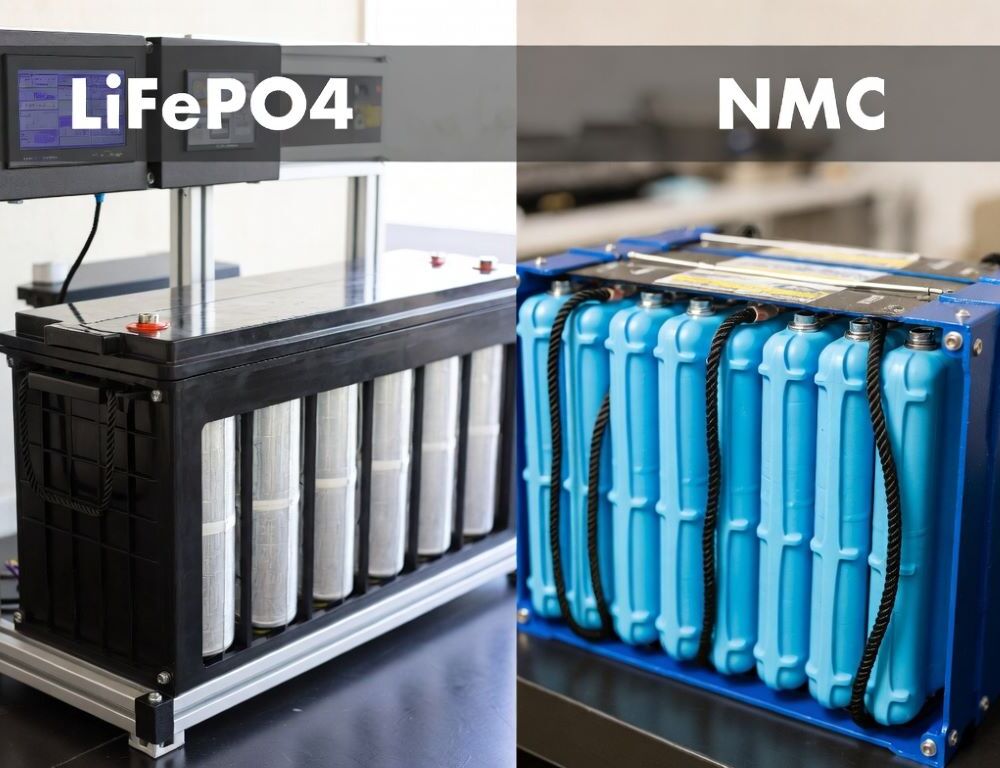
LiFePO4 vs NMC for home batteries is mostly a trade-off between safety margin, footprint, and cost per usable kWh. Both can work well at home, but the “best” choice changes once you factor in where the battery sits, how often it cycles, and how tight the space is.
The practical goal is simple: get the backup time you need without creating heat, noise, or maintenance problems you can’t control.
- Which quick checks decide LiFePO4 vs NMC for a home setup?
- Which chemistry fits home energy storage trends and availability?
- Which differences in energy density change the size of a backup system?
- Which safety and lifetime trade-offs matter most in a house or apartment?
- Which settings and operating habits reduce stress for either chemistry?
- Which mistakes make LiFePO4 vs NMC comparisons misleading?
- Which warning signs mean it is time to stop and call the installer?
- What is the simplest takeaway when choosing LiFePO4 vs NMC for home?
Which quick checks decide LiFePO4 vs NMC for a home setup?
A fast check for LiFePO4 vs NMC starts with location, cycling frequency, and space constraints. Use these checks before comparing brand features:
- Define the placement: Living space, garage, balcony, technical room, detached shed.
- Define the cycling pattern: Rare outages only, daily load shifting, solar self-consumption.
- Define the limits: Max cabinet size, max weight, ventilation options, ambient temperature in summer.
- Define the priority: Lowest risk margin, smallest footprint, lowest lifetime cost, fastest recharge.
- Verify install constraints: Local code requirements, required clearances, permitted indoor chemistry.
The check is valid if it produces one clear “must-have” (for example, indoor placement with low noise and extra safety margin) and one clear “nice-to-have” (for example, smaller footprint).
Which chemistry fits home energy storage trends and availability?
Home energy storage availability has been shifting toward LiFePO4 packs in recent years, especially in stationary battery systems. A Clean Energy Ministerial report (citing IEA tracking) notes that LFP reached roughly 80% of the total BESS market in 2023, which affects what is easiest to buy, service, and warranty.
Validation step: read the product’s datasheet and confirm the chemistry, warranty terms (cycles and years), and the certification list, not just the marketing page.
Which differences in energy density change the size of a backup system?
Energy density differences between LiFePO4 and NMC can translate into a larger cabinet for the same kWh when space is limited. Fraunhofer ISI’s 2022 report on Li-ion cell formats highlights that LFP-based large-volume cells stay under about 500 Wh/L through 2025, which helps explain why some high-energy chemistries can be more compact at the same storage size.
A sizing baseline is easiest when you turn your needs into Wh first: a Wh estimate for key home loads makes the “kWh you actually need” question less guessy.
Validation step: compare usable kWh (not nominal), the cabinet dimensions, and the continuous power rating (kW) because a big battery with low power output can still feel “weak” during startup surges.
Which safety and lifetime trade-offs matter most in a house or apartment?
Safety and lifetime trade-offs for LiFePO4 vs NMC become most visible under heat, high state of charge, and frequent cycling. A 2025 World Electric Vehicle Journal paper summarizes prior work that LFP is generally more thermally stable, while NMC tends to offer higher energy density but can carry higher thermal runaway risk under comparable stress, and it also reports faster degradation for NMC under similar conditions.
Practical decision point:
- Indoor or close-to-living-space placement usually favors the chemistry with a bigger thermal stability margin.
- Very tight space constraints can make compactness more important, but only when the product has strong safety testing and the installation is designed to handle heat and fault scenarios.
Validation step: confirm the battery system’s safety test documentation (for example, recognized BESS safety standards and enclosure design), and confirm whether the warranty is written around daily cycling or only occasional use.
Which settings and operating habits reduce stress for either chemistry?
Operating habits that keep batteries cooler and reduce time spent at very high charge improve results for both chemistries.
- Avoid long-term storage at 100% unless the manufacturer explicitly recommends it for your use case.
- Keep ventilation paths clear and avoid enclosing the battery in a tight, unventilated box.
- Use the manufacturer’s recommended charge and discharge limits when daily cycling is enabled.
- Update firmware only from official channels and record the version so troubleshooting stays reproducible.
Validation step: check the battery’s temperature and power logs (if available) during a normal day and during a high-load event; stable temperature and no repeated power throttling are good signs.
Which mistakes make LiFePO4 vs NMC comparisons misleading?
LiFePO4 vs NMC comparisons go wrong when specs are compared without the same conditions and without the same “usable” definition.
- Comparing nominal kWh instead of usable kWh (after reserve limits).
- Ignoring power limits (kW) and surge behavior, then blaming the chemistry.
- Treating cycle life claims as universal, even though they depend on depth of discharge, temperature, and charge level habits.
- Over-optimizing for size, then placing the battery where heat and ventilation are worst.
The comparison becomes reliable when every number you use can be matched to a test condition or a warranty clause.
Which warning signs mean it is time to stop and call the installer?
Several warning signs should trigger an immediate stop and a service call, regardless of chemistry.
- Persistent overheating, swelling, unusual smells, or repeated protective shutdowns.
- New buzzing, clicking, or rapid fan ramping under normal load.
- Any visible damage to cables, connectors, or enclosure seals after transport or installation.
- Frequent error codes tied to insulation faults, DC bus faults, or internal temperature sensors.
Safer alternative: isolate the system as instructed by the manufacturer, keep the area ventilated, and avoid repeated restarts. If the backup plan is a portable unit instead of a fixed install, choosing a power station for an apartment helps avoid common sizing and power-output mistakes.
What is the simplest takeaway when choosing LiFePO4 vs NMC for home?
The simplest takeaway is that LiFePO4 often wins for home use when safety margin, predictable cycling, and practical ownership matter more than compactness, while NMC can be attractive when the footprint must be as small as possible and the system’s safety design is clearly documented. A good choice is the one you can install safely, cool reliably, and validate with real load numbers.
Sources: