
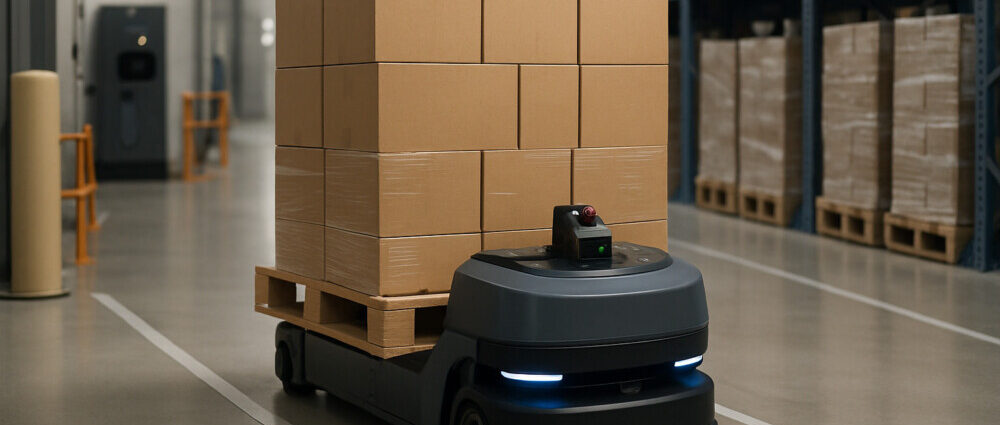
What is AGV? AGV usually stands for automated guided vehicle, a mobile machine that moves materials from one place to another without a human driver. AGVs are widely used in warehouses, factories, distribution centers, and hospitals where repeatable transport tasks need to be done safely, accurately, and with less manual labor.
The term can show up in a few different contexts, but in technology and industrial operations, automated guided vehicle is the meaning most people are looking for. These systems sit between traditional forklifts and more advanced autonomous mobile robots, giving businesses a practical way to automate internal transport.
AGV meaning in practical terms
AGV meaning in practical terms is a self-moving vehicle that follows a defined route to carry goods, pallets, carts, bins, or equipment. Instead of being driven by a person, it uses guidance systems, sensors, and software to travel through a facility.
Most AGVs are designed for predictable environments. A warehouse might use them to move inventory from receiving to storage, while a factory might use them to carry parts between production lines. In hospitals, AGVs can transport linens, meals, medicines, or waste carts.
Common AGV types include:
- Towing AGVs that pull carts or trailers
- Unit load AGVs that carry pallets, bins, or containers
- Forklift AGVs that lift and place loads
- Assembly line AGVs that support production flow
How an AGV works
An AGV works by combining navigation, obstacle detection, and task control to move through a set operating area. The vehicle receives instructions from onboard systems or fleet management software, then follows a route to complete a transport job.
Navigation can be handled in several ways:
- Magnetic tape or wires embedded or placed on the floor
- Laser guidance using reflectors in the facility
- Vision guidance using cameras and markers
- Natural feature navigation using maps of walls, racks, and fixed objects
Sensors help the AGV detect people, equipment, or obstacles in its path. If something blocks the route, the vehicle may slow down, stop, or request a new task path depending on how advanced the system is. Power usually comes from rechargeable batteries, and many fleets use automatic charging stations to reduce downtime.
What an AGV system includes
An AGV system includes the vehicle, the guidance method, traffic control logic, and charging support. In larger deployments, it also includes software that assigns jobs, tracks vehicle status, and helps prevent route conflicts.
That software matters because a single AGV can be useful, but a coordinated fleet is where automation starts to deliver major gains in throughput and labor efficiency.
Where AGVs are used
AGVs are used wherever materials need to move repeatedly across fixed routes. They are especially valuable in environments with high volume, routine transport tasks, and pressure to reduce handling errors.
Typical use cases include:
- Moving pallets from receiving docks to storage areas
- Supplying production lines with parts and raw materials
- Transporting finished goods to packing or shipping zones
- Carrying carts in hospitals and large facilities
- Handling work-in-progress inventory between stations
AGVs are most effective when workflows are stable and routes are well defined. If the layout changes constantly or traffic is highly unpredictable, an autonomous mobile robot may be a better fit.
AGV vs AMR: the key difference
AGV vs AMR comes down to how the vehicle navigates and responds to change. An AGV typically follows predefined routes, while an AMR, or autonomous mobile robot, can make more dynamic navigation decisions in real time.
This difference affects flexibility, cost, and deployment complexity. AGVs often make sense for structured facilities where the job is repetitive and the path is known. AMRs are usually better in spaces where routes shift often or where the robot needs to reroute frequently around changing obstacles.
Many buyers compare AGV and AMR because both automate transport, but they are not interchangeable in every operation. Choosing the right one depends on layout stability, load type, traffic conditions, and integration needs.
Why businesses use AGVs
Businesses use AGVs to improve consistency, reduce manual transport work, and make internal logistics more efficient. The strongest value usually comes from repetitive movement tasks that do not need human judgment every time.
Main benefits include:
- Lower labor demand for routine material movement
- More predictable transport timing
- Better safety through controlled vehicle behavior
- Reduced product damage from manual handling
- Improved traceability when connected to warehouse or factory systems
AGVs are not automatically the right choice for every site. A good fit depends on route stability, floor conditions, load consistency, and whether the facility can support charging, maintenance, and traffic planning. If a deployment underperforms, the first thing to verify is route design and traffic flow. If those are sound, the next step is usually to check sensor coverage, software integration, and battery uptime.
For most readers asking what is AGV, the short answer is simple: it is an automated guided vehicle used to move materials inside controlled environments. The longer answer is that AGVs are a practical automation tool for facilities that want reliable, repeatable transport without relying entirely on manual driving.