
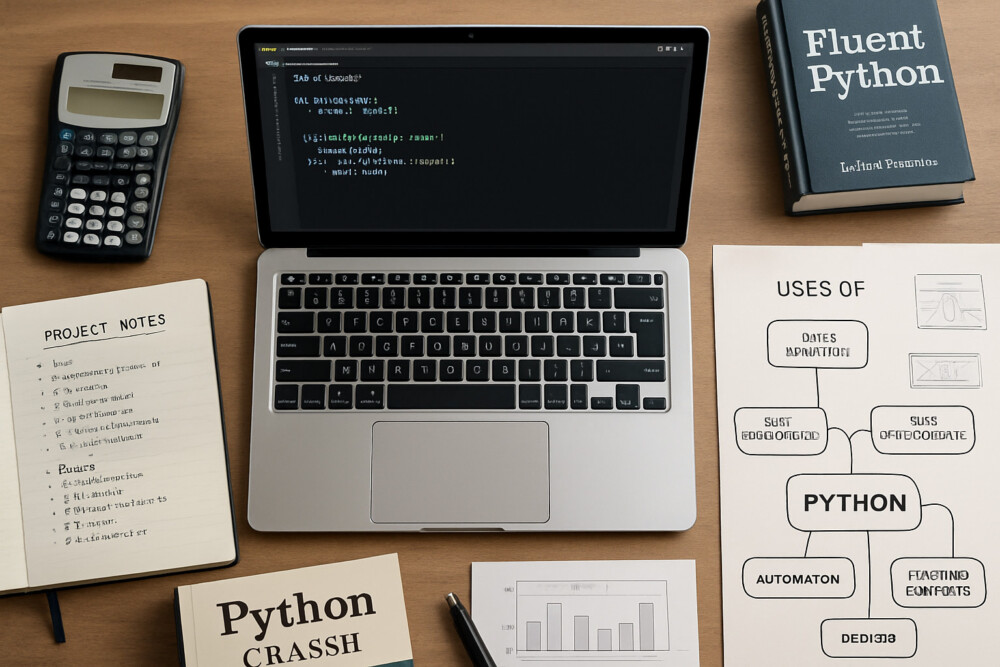
Python is used in data analysis, web development, automation, artificial intelligence, and many other areas where fast development and readable code matter. It is a common choice not only for beginners, but also for teams that need to test ideas quickly and keep projects manageable without unnecessary complexity.
Main areas where Python is used
Python is used where flexibility, a large library ecosystem, and a fast start without heavy infrastructure are important.
- Web development — backend systems for websites, APIs, admin panels, and online services.
- Data analysis — working with spreadsheets, visualization, statistics, and reporting.
- Artificial intelligence and machine learning — model training, prototyping, and neural network workflows.
- Automation — scripts for repetitive tasks, file processing, and service-to-service integrations.
- Testing — automated tests for websites, apps, and software interfaces.
- DevOps and system administration — helper tools, monitoring, and environment management.
- Education and science — learning projects, experiments, and process modeling.
Why Python is so often chosen for real projects
Python is used in commercial and educational projects because of its simple syntax and broad ecosystem of ready-made solutions.
The language works well for teams that want to move quickly from an idea to a working prototype. For many tasks, it takes less boilerplate code, which shortens development time and reduces the chance of mistakes.
- code is easy to read and maintain;
- there are libraries for almost any common task;
- it is well suited to rapid prototyping;
- it runs on different operating systems;
- it has a strong community and plenty of examples.
Where Python is strongest and where it has limits
Python is used most effectively in tasks where development speed, analytics, and automation matter more than maximum core performance.
For web services, internal tools, data science, and AI, Python often offers the best balance between convenience and capability. For highly resource-intensive real-time systems, game engines, or low-level components, C++, Rust, or other languages are often a better fit.
If a project needs to handle large volumes of similar calculations very quickly, Python is often paired with C extensions, optimized libraries, or separate services built on another technology.
How to tell whether Python fits your task
Python is used effectively when you need a practical tool for business, analytics, or automation without a long development cycle.
- It fits if you need to build an MVP, script, or internal service quickly.
- It fits if the task involves data, APIs, parsing, or machine learning.
- It fits if code maintainability and easier hiring matter.
- It is less suitable if minimal latency or very high core-level performance is critical.
A simple practical check is this: if a clear library exists and a prototype can be built in a few hours or days, Python is usually a strong choice. If performance is the bottleneck, it is worth evaluating alternatives or a hybrid architecture from the start.
Short summary
Python is used across a wide range of fields, but it is valued most for its versatility, fast development, and strong capabilities in data work and automation. That is why it remains one of the most practical tools in modern development.