
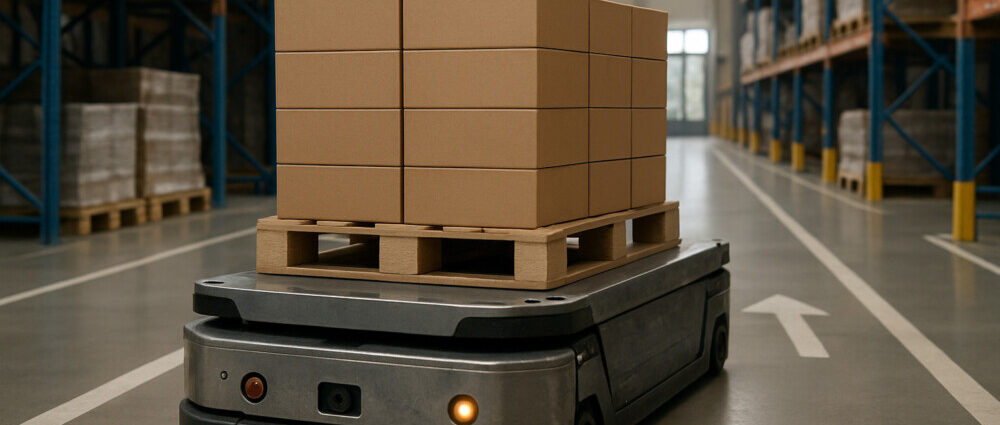
An automatic guided vehicle is a driverless material-handling vehicle that follows a defined route or navigation system to move goods inside warehouses, factories, and distribution centers. It sits between manual carts and fully autonomous mobile robots, giving businesses a practical way to automate repetitive transport without redesigning every workflow from scratch.
Automatic guided vehicle systems solve repetitive internal transport
Automatic guided vehicle systems reduce manual movement of pallets, bins, carts, and components across predictable routes. They are commonly used for line-side delivery in manufacturing, pallet transfer in warehouses, and movement between storage, packing, and shipping areas.
The main value is consistency. A properly deployed AGV can run the same route for long periods with stable timing, fewer handling errors, and less dependence on forklift traffic for routine moves. That makes AGVs especially useful in facilities with fixed paths, recurring loads, and clear pickup and drop-off points.
For many operations, the business case comes down to three things:
- Lower labor demand for repetitive transport tasks
- Safer traffic flow in shared industrial spaces
- More predictable material movement for production planning
Automatic guided vehicle navigation usually relies on guided paths, embedded markers, lasers, magnetic tape, QR-style floor references, or sensor-based positioning. The right method depends on how fixed or flexible the facility layout is.
Fixed-guide AGVs work best in stable layouts
Fixed-guide AGVs perform best when routes rarely change and traffic patterns are easy to control. These vehicles may follow magnetic tape, wires, or other physical guidance methods that make deployment straightforward and predictable.
This approach is often cheaper to understand and maintain, but route changes can require floor work or system updates. It suits plants with repeatable production flows more than fast-changing fulfillment environments.
Natural navigation AGVs use onboard sensors and mapped surroundings to move with less dependence on physical guides. They can adapt more easily when aisles, stations, or workflows shift over time.
This flexibility can reduce infrastructure changes, but it also raises the need for careful mapping, sensor calibration, and traffic management. If an AGV rollout struggles, the first thing to verify is whether the vehicle is consistently localizing itself in the same physical position on repeated runs. If it is not, remap the area and check for environmental changes such as moved racks, reflective surfaces, or blocked markers.
Automatic guided vehicle types vary by load and task
Automatic guided vehicle types are designed around the material being moved and the handoff point required by the process. Choosing the wrong type usually creates bottlenecks long before software does.
Tugger AGVs move multiple carts efficiently
Tugger AGVs are built to pull trains of carts along repeatable routes. They are common in manufacturing because one vehicle can support several downstream stations in a single run.
Unit-load AGVs handle pallets and containers
Unit-load AGVs carry pallets, racks, or large containers directly on the vehicle body. They fit warehouse transfer tasks where loads need stable, automated movement between fixed stations.
Forklift-style AGVs automate pickup and drop-off
Forklift-style AGVs lift and place loads at defined heights, making them useful for pallet put-away and retrieval. They can replace part of a manual forklift workflow, but site preparation matters more because rack alignment, floor condition, and clearance all affect reliability.
A simple deployment check is to test repeated pickup and drop-off at the same station under normal traffic conditions. If the vehicle completes the cycle consistently without alignment faults or hesitation, the process is likely ready for wider use. If it does not, inspect floor flatness, pallet quality, station positioning, and sensor visibility before changing software settings.
Automatic guided vehicle benefits come with operational limits
Automatic guided vehicle benefits are strongest in structured environments with clear rules, repeatable demand, and disciplined facility layout. AGVs improve throughput stability, reduce routine travel time, and support safer separation between people and vehicles.
The limits are just as important. AGVs are less effective when loads vary constantly, pickup points are informal, aisles are frequently blocked, or processes depend on human judgment at every stop. In those cases, a more flexible mobile robot system may be a better fit.
Cost also depends on more than the vehicle itself. Charging strategy, fleet software, traffic control, floor quality, integration with conveyors or warehouse systems, and maintenance planning all shape the real return on investment.
Automatic guided vehicle planning should start with process stability
Automatic guided vehicle planning works best when the first question is not vehicle brand but route discipline. Facilities get better results by identifying repetitive moves, measuring travel frequency, standardizing load presentation, and removing avoidable obstacles before automation starts.
A practical shortlist for evaluation includes:
- Whether routes stay consistent for most of the week
- Whether pickup and drop-off points can be standardized
- Whether floor conditions support repeatable travel
- Whether the current process already has measurable delays or labor strain
- Whether operators, pedestrians, and forklifts can share space safely
If those conditions are mostly true, an automatic guided vehicle can be a strong fit. If they are not, the better next step is often process cleanup first, then automation after the workflow becomes more predictable.